Table of contents
Open Table of contents
Introduction
The XT Box’s release put Tari’s mining ecosystem to its first real market test.
The discussion went beyond a single mining rig, bringing hashrate, earnings, and the network’s economic model into direct comparison with conditions on the ground.
1. Miner Skepticism and Community Debate
In mid-October 2025, well-known mining YouTuber RedPandaMining (RPM) reviewed Goldshell’s newly released XT Box, a compact ASIC miner for the Tari network running the SHA3X algorithm.
That was roughly 12 days before this article was written.
He made his position clear at the start of the video:
“I don’t recommend anyone buy this machine.”
The remark prompted widespread discussion among miners.
For years, RedPandaMining has reviewed hardware from the perspective of small-scale miners, with a direct, unvarnished style.
When a channel known for mining hardware reviews openly advises against a purchase, it signals that Tari is moving beyond an idealized narrative and into a market test centered on returns and risk.
2. Falling Earnings: From $66 to $37
RPM’s video traced the XT Box’s rapid decline in earnings:
At launch, it brought in around $66 per day.
A week later, that had fallen to $37.
He even predicted that another week could bring it down to just $3–5 per day.
His explanation was specific:
Tari’s total network hashrate had risen from approximately 68 TH/s to 90 TH/s, an increase of approximately 22 TH/s in just seven days.
He estimated that roughly 50 additional XT Boxes coming online would be enough to halve mining earnings across the network.
Another 50 could push earnings below the point of profitability.
In terms of mining economics, this meant hashrate was expanding much faster than the ecosystem was growing.
For miners, that was a serious risk signal.
3. Risks and Structural Concerns
RedPandaMining’s criticism focused on several areas:
- A small market capitalization: Tari’s market cap was around $6 million, with daily block rewards worth roughly $6,000. He considered that too small to support the long payback period of ASIC hardware.
- The algorithm split: Tari uses four algorithms: Monero RandomX (CPU), Tari RandomX (CPU), SHA3X (mainly ASIC), and Cuckaroo29 (GPU), each accounting for 25%. That leaves SHA3X with only a quarter of total issuance.
- The 30% premine: He compared Tari’s initial 30% premine and lockup structure with projects such as Alephium, IronFish, and Kadena, arguing that it could create a cycle of launch, selling pressure, and lost trust as mining hardware first ships.
- Goldshell’s release strategy: He argued that Goldshell tends to release miners with short earning windows early in a coin’s life. Reviewers and distributors benefit first, while ordinary buyers often enter at the peak.
RPM emphasized that he appreciated the manufacturer providing a review unit, but would not recommend a product that could lose users money.
4. Tari’s Longer-Term Perspective
The video drew considerable attention among miners and highlighted a longstanding tension:
Miners and protocol builders operate on different time horizons.
For miners, the central considerations are how long the hardware takes to pay for itself and the cost of electricity.
For Tari, the goal is to build a composable privacy protocol stack (Layer1 + Ootle Layer2), providing privacy and scalability for future DeFi, NFT, GameFi, social, and payment applications.
RedPandaMining’s hashrate analysis is sound, but it does not address longer-term factors in the Tari ecosystem, such as Blink’s payment experiments, Ootle Layer2’s burn mechanism, and the emphasis on privacy shared with the Monero community.
These may not yet translate directly into earnings, but they underpin the network’s longer-term prospects.
5. Short-Term Volatility and the Longer-Term Test
RPM’s video offers a useful case study for the Tari community.
It shows that when a project moves from ideas into market competition, it faces a direct test of earnings, risk, and sustainability.
Miners focus on the numbers; developers focus on the ecosystem.
Tari’s challenge is to find a lasting balance between the two.
In the short term, declining XT Box earnings are almost inevitable.
Over the longer term, however, if Layer2 matures, Blink attracts more users, and cross-chain stablecoin liquidity improves, the pessimism among miners could turn out to have marked a market bottom.
6. Follow-Up: Comparing the Data 12 Days Later
As of October 28, 2025, roughly 12 days after RPM published his video, the XT Box’s performance had taken a different turn.
MiningNow’s live earnings data showed the following specifications and returns:
Around 580 GH/s of hashrate, 400W of power consumption, and a price of $1,980 per unit.
At an electricity rate of $0.07/kWh:
Daily revenue was $22.60, electricity cost $0.67, and net profit approximately $21.93 per day.
The image shows XT Box daily revenue of $22.60, electricity costs of $0.67, and net profit of $21.93 per day.
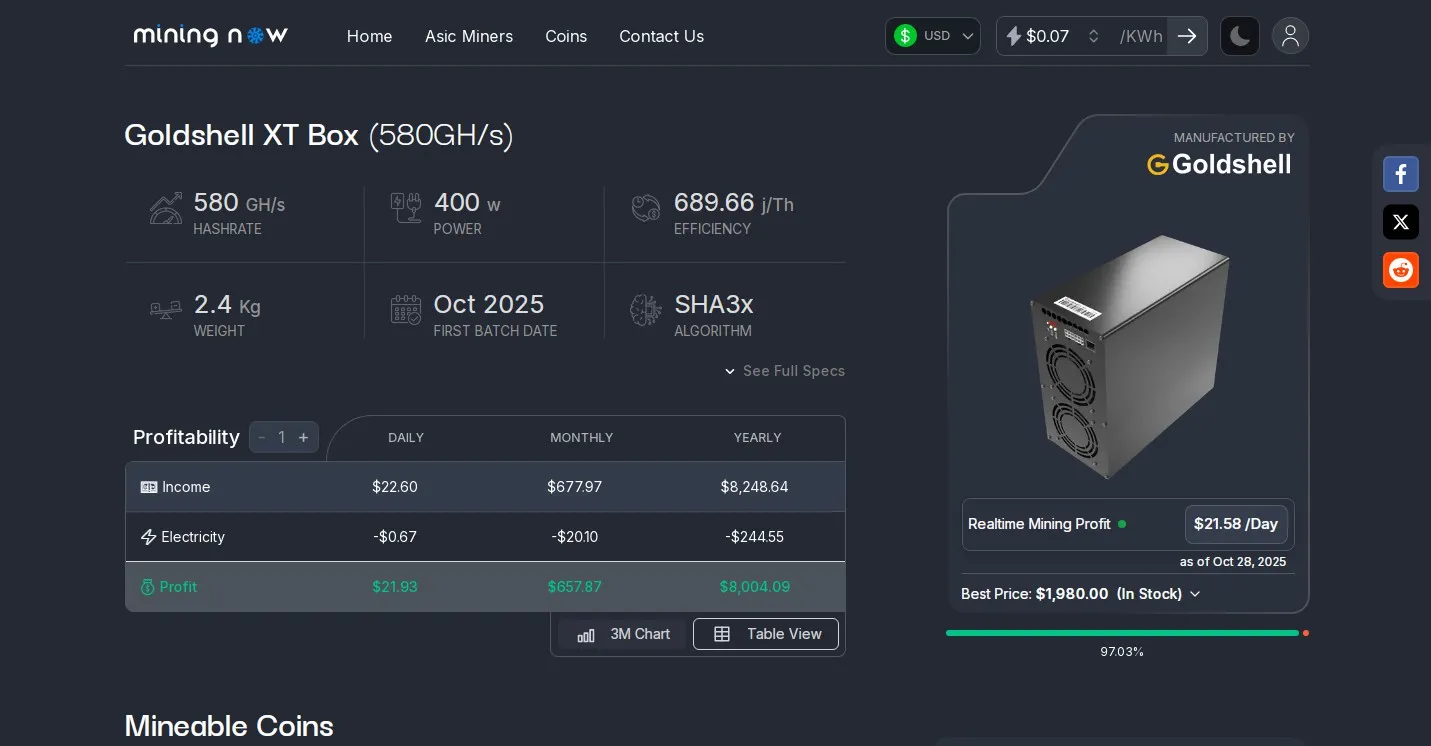
(XT Box earnings data. Source: MiningNow, October 28, 2025.)
Meanwhile, Tari mainnet hashrate had risen substantially over those 12 days:
SHA3X hashrate had grown from around 90 TH/s when the video was recorded to 342.1 TH/s, nearly quadrupling.
The network had 15,103 active miners, while the average block time remained at 2 minutes, with the system running stably.
The image shows SHA3X hashrate of 342.1 TH/s, 15,103 active miners, and an average block time of 2 minutes.
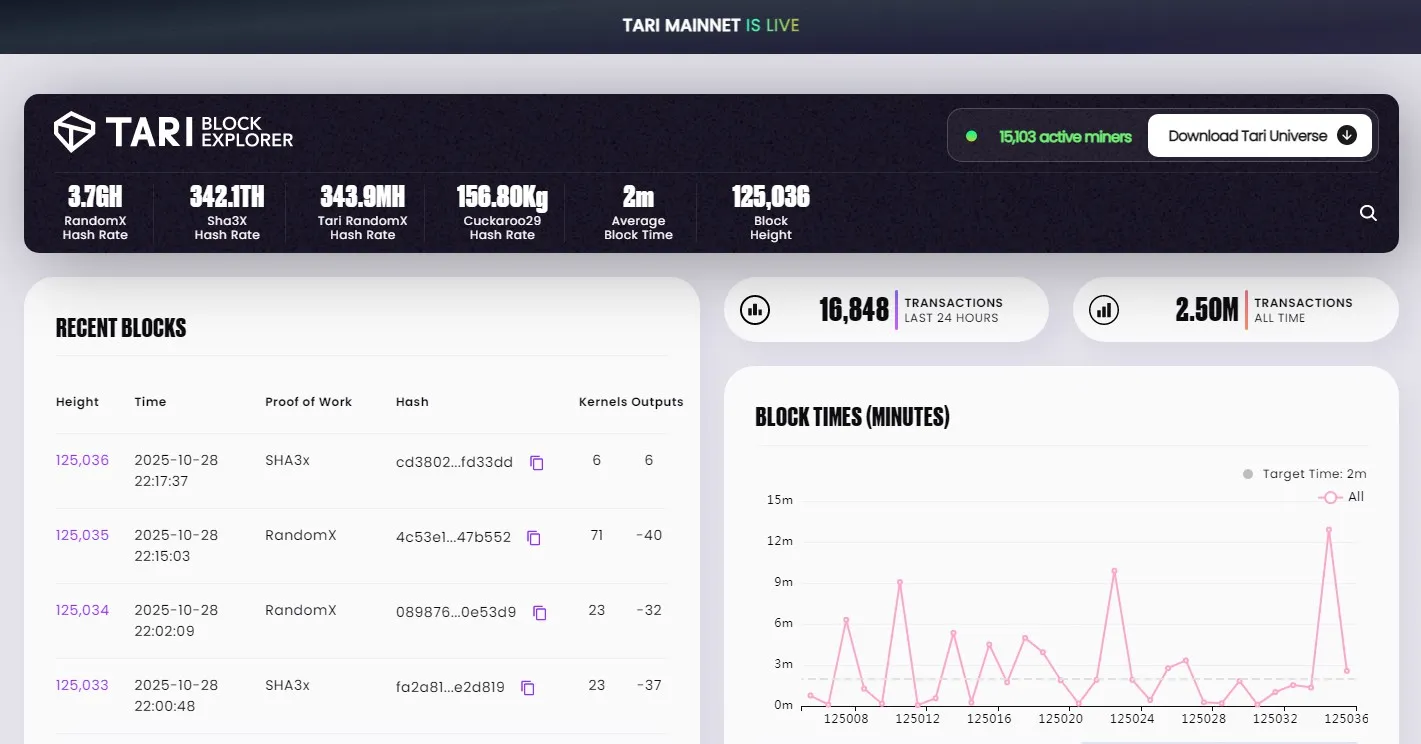
(Tari network status. Source: Tari Block Explorer, October 28, 2025.)
The data above suggests that Tari’s mining ecosystem did not quickly collapse as the commentary had anticipated. Instead, it entered a more complex and dynamic phase.
Overall, the XT Box’s performance did not match the early pessimistic forecasts.
The network continued to grow, and although earnings fell, they remained within an acceptable range. Tari’s mining economy appeared to be moving from early hype toward a more realistic adjustment.
XT Box earnings will continue to depend on coin-price movements, changes in hashrate, and progress in ecosystem development.
For the community, this is both a real market test and a case worth following over the longer term.
Sources
This article draws on the following public sources:
- Original video (RedPandaMining):
https://www.youtube.com/watch?v=C3GCBngqAgE - Live earnings data (MiningNow):
https://miningnow.com/asic-miner/goldshell-xt-box-580gh-s - Tari mainnet block explorer (Tari Explorer):
https://explore.tari.com - Manufacturer’s website (Goldshell):
https://www.goldshell.com/product/goldshell-xt-box