Table of contents
Open Table of contents
- 1. A Trillion-Dollar Shift
- 2. Beneath the Stablecoin Wave: Digital Dollar Colonialism
- 3. The Financial Logic Behind Standard Chartered’s Forecast
- 4. The Geography of the Shift: Where It Starts and Where It Scales
- 5. Beyond Banks, and Then Beyond Stablecoins
- 6. Tari: A Private Settlement Layer Beyond Stablecoins
- 7. XTM: From Fuel for Privacy to the Heart of an Economy
- 8. Blink: A Bridge Between Two Worlds
- 9. Closing Thoughts: Stablecoins Extend the Dollar; Tari Carries Freedom Forward
1. A Trillion-Dollar Shift
In October 2025, Standard Chartered published a global research report with a striking projection:
By 2028, more than $1 trillion could leave banking systems in emerging markets and move into stablecoins.
The report argues that adoption of dollar-pegged stablecoins is accelerating worldwide as payment networks and core banking services increasingly move outside the banking sector.
In emerging markets facing high inflation and currency depreciation, stablecoins are giving people what amounts to a dollar account.
Standard Chartered forecasts that stablecoins held as savings in emerging markets could grow from $173 billion to $1.22 trillion.
That would mean roughly $1 trillion leaving banks for decentralized dollar networks over the next three years.
This is more than a financial forecast. It points to a structural change in how trust is organized around the world.
As deposits leave banks and money becomes a digital asset that can move freely, the boundaries of financial sovereignty are being redrawn.
2. Beneath the Stablecoin Wave: Digital Dollar Colonialism
The rise of stablecoins looks like an innovation within crypto, but it is redrawing the monetary map.
It allows anyone, anywhere, to open a “dollar account” in minutes and make payments, save, and invest onchain without going through a bank.
Yet decentralized networks are not the winners of this revolution.
Stablecoins still rest on dollar claims, centralized custody, and regulatory frameworks.
They change the route, but not who ultimately holds control.
Money once depended on the state.
Now, it increasingly depends on the issuer.
The dollar extends its influence not through diplomacy and bonds, but through smart contracts and APIs.
An Argentine shopkeeper, a Nigerian student, and a Filipino developer become “nodes in the dollar network,” often without realizing it.
As CoinDesk put it, Standard Chartered’s forecast is not an exaggeration but a reflection of the dollar’s digital expansion.
The stablecoin boom is, at its heart, digital dollar colonialism.
3. The Financial Logic Behind Standard Chartered’s Forecast
Standard Chartered’s assessment stands out because it identifies a central trend in the development of stablecoins:
Structural demand for alternatives that provide dollar exposure in emerging markets is reshaping the boundaries of traditional banking.
There is a clear financial logic behind this.
Emerging markets have long faced structural problems with currency volatility, capital controls, and inefficient banking systems.
Stablecoins, particularly dollar stablecoins, offer a low-cost, highly liquid form of “digital dollar account.”
They bypass the barriers to opening a dollar account at a traditional bank, allowing users to hold and transfer dollar assets at very little cost.
This goes beyond technical convenience. It changes the financial architecture itself:
From reliance on local banks to a global, open system of onchain dollars.
Individuals are not the only ones driving this shift.
Businesses’ needs for cross-border payments and treasury management are also important forces behind it.
Traditional wire transfers are slow and expensive, while stablecoin settlement is almost instantaneous and costs very little.
As financial giants such as Mastercard, Stripe, and Citi build stablecoin payment channels, the combination of compliance and infrastructure is preparing the ground for another wave of capital migration.
Clearer regulation is a catalyst.
The US Congress is advancing legislation such as the Clarity for Payment Stablecoins Act to establish clear regulatory boundaries for issuers.
Federal Reserve officials describe stablecoins as a “pillar of payment innovation” and warn banks that they risk being sidelined if they do not embrace the trend.
Standard Chartered’s trillion-dollar forecast is therefore no exaggeration.
It reveals an irreversible shift: demand for dollarization in emerging markets is finding a new outlet through more efficient and transparent technology.
For banks, this means the traditional system is being displaced.
For the stablecoin ecosystem, it offers a route to becoming the foundation of global digital finance.
As BlockBeats summarized in its news bulletin, stablecoins are becoming more than a payment tool.
They are emerging as a new structural channel for preserving wealth and moving money across borders.
4. The Geography of the Shift: Where It Starts and Where It Scales
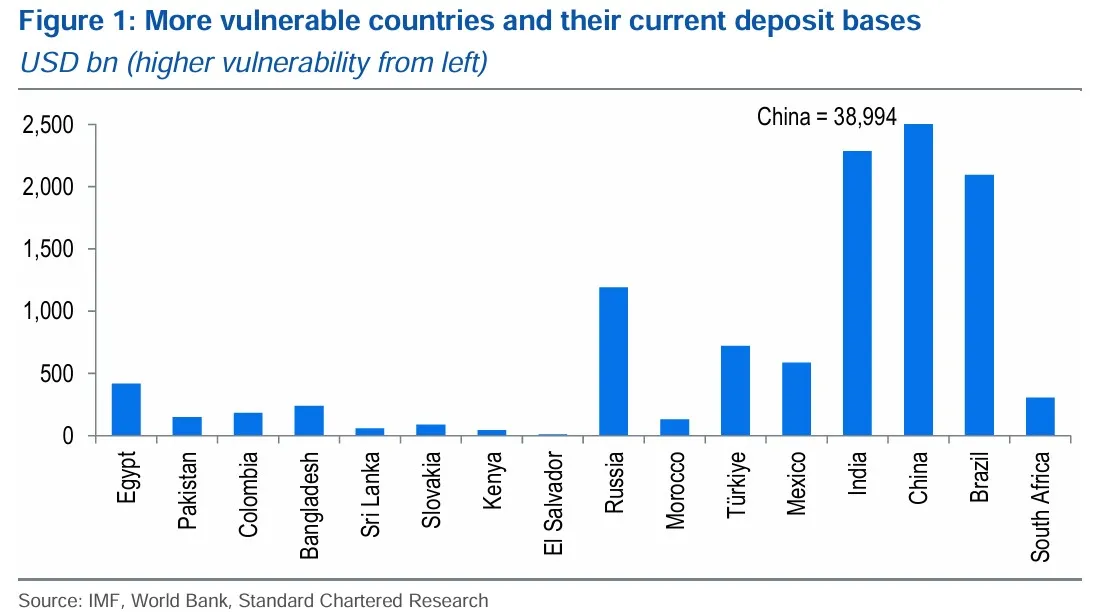
Standard Chartered’s report includes a revealing chart showing which countries’ banking systems are most vulnerable to deposit outflows.
Source: IMF, World Bank, Standard Chartered Research (2025)
The chart suggests that countries such as Egypt, Pakistan, Bangladesh, and Colombia, facing inflation and foreign-exchange shortages, are among the first to feel the effects.
Larger economies such as China, India, and Brazil have much bigger banking systems, but their sheer size means they could amplify outflows in absolute terms.
The chart traces a possible geographical path for this migration into stablecoins:
Money first moves out of systems with high inflation and high currency risk, then spreads to midsized economies through business settlement and cross-border savings, eventually reaching the largest banking systems.
Standard Chartered notes:
“The spread of stablecoins in emerging markets means depositors are hedging local-currency risk through onchain dollars.”
In other words, this is not speculation but a structural reallocation of assets.
Stablecoins provide a technology-based route to the dollar as a safe haven, making inroads into sovereign monetary systems through market forces.
This is the backdrop against which Tari operates, and the challenge it faces.
If stablecoins represent a global redistribution of finance through dollarization, Tari is building a way to reclaim sovereignty over value through privacy: a decentralized, censorship-resistant financial order that returns control to individuals.
5. Beyond Banks, and Then Beyond Stablecoins
Stablecoins are not the endpoint of financial change.
They solve the problem of digitizing dollars, but not the tension between trust and control.
When users discover that their funds can be frozen and their accounts blacklisted, a question follows:
“If someone else still controls my assets, what have we really changed?”
The direction of financial evolution becomes clearer:
- The banking stage: accounts depend on banks;
- The stablecoin stage: accounts depend on issuers;
- The decentralized stage: control rests with the individual.
Stablecoins weaken banks while further consolidating the dollar’s dominance in global finance.
In the next stage, the boundaries of privacy are being redrawn beyond the dollar system.
That is the direction a new generation of privacy networks, including Tari, is trying to take.
6. Tari: A Private Settlement Layer Beyond Stablecoins
Tari is not a competitor to stablecoins, but the layer that comes after them.
It serves people and businesses seeking freedom, privacy, and speed in their financial transactions.
The Tari Base Layer provides strong privacy and decentralized settlement.
Ootle Layer2 provides a high-throughput, low-cost layer for programmable transactions.
Blink connects Tari to the real world, making these technologies easier to use in everyday life.
| Layer | Current examples | Tari’s corresponding role |
|---|---|---|
| Reserve layer | USD / USDC / USDT | The basis for stablecoin pegs |
| Settlement layer | Monero / Bitcoin | Tari Base Layer (XTM) |
| Application layer | Solana / TON | Ootle Layer2 |
| User layer | Telegram / DeFi | Blink / Universe |
A trillion dollars entering stablecoins is only the first act of this migration.
The private settlement layer Tari is building is not its final destination, but an extension of and response to that movement: a continuation and evolution of how value works.
Just as BTC established the framework for decentralized money and Monero took privacy and individual sovereignty further, Tari carries forward that technological pursuit of freedom and sovereignty, making privacy the norm in systems of value rather than the exception.
7. XTM: From Fuel for Privacy to the Heart of an Economy
Tari’s native coin, XTM, is not just another payment coin.
It is the fuel for privacy without reliance on trusted intermediaries, and the driving force of the Tari economy.
| Dimension | Stablecoins | XTM |
|---|---|---|
| Issuance | Centralized | Decentralized mining |
| Asset type | Dollar claims | Native asset |
| Regulatory dependence | US legal system | Cryptographic self-governance |
| Privacy | Traceable | Anonymous by default |
| Uses | Store of value, payments | Settlement, incentives, governance |
In Tari’s design, stablecoins are the bridge into the ecosystem, while XTM is the engine of its internal economy.
It does not fight the dollar. It works on a different level, returning money to individual control and the freedom that privacy provides.
Where stablecoins offer convenience within a regulated framework, Tari seeks financial autonomy without reliance on trusted intermediaries.
8. Blink: A Bridge Between Two Worlds
Blink is the interface between Tari and the real world.
It combines stablecoin payments, AI-assisted ordering, and private settlement, allowing users to experience decentralization through familiar shopping and payment activities.
In Blink’s vision, AI, payments, identity, and incentives are no longer separate. They form a single, integrated crypto experience.
If stablecoins make the dollar programmable, Blink makes freedom something people can experience firsthand.
9. Closing Thoughts: Stablecoins Extend the Dollar; Tari Carries Freedom Forward
Standard Chartered’s forecast points to a sweeping shift:
Over the next three years, emerging markets will see a wave of activity moving beyond banks, with hundreds of billions, perhaps more than a trillion dollars, migrating into onchain dollar systems.
But the migration will not stop at the dollar.
As people experience the convenience of stablecoins, they will also reconsider the limits of trust.
Real financial freedom is not just convenience. It is sovereignty.
Stablecoins bring the world closer to the dollar.
Tari brings it closer to choice.
If Standard Chartered is measuring where money flows, Tari seeks to protect the direction value takes.
Stablecoins change the form of trust.
Tari puts choice back at its heart.
Sources
- BlockBeats news bulletin: Standard Chartered forecasts $1 trillion will flow into stablecoins over the next three years (October 7, 2025)
- Cointelegraph – Standard Chartered: $1 trillion could move from EM banks to stablecoins by 2028 (October 6, 2025)
- CoinDesk – Stablecoin surge could trigger $1T exit from emerging market banks: Standard Chartered (October 6, 2025)