Table of contents
Open Table of contents
Introduction
Following RedPandaMining’s review, another longtime crypto mining YouTuber, Rabid Mining (Rabid), published a detailed assessment of the Goldshell XT Box.
Unlike RPM’s firm warning against buying it, Rabid took a more neutral, analytical approach. Rather than dismissing the miner outright, he treated it as a short-term experiment with measurable results.
In his view, the XT Box was a high-risk miner with highly volatile returns, but not one without potential.
1. A Tone of Cautious Realism
Rabid opened the video with three points:
“XT Box earnings are falling.”
“But this decline is mainly down to Tari’s price, not a surge in hashrate.”
“Still, this is 100% a gamble.”
This contrasted sharply with RedPandaMining’s assessment. RPM attributed the earnings collapse to an influx of hashrate.
Rabid identified the main cause as a 35–40% decline in the coin’s price, with only a limited number of new machines joining the network.
In other words, Tari’s risk came from the broader market rather than its internal structure.
He saw the XT Box less as a failed product than as a case study of a particular market phase:
“Earnings have fallen, but the system hasn’t collapsed. The real problem is the price, not the network.”
2. XT Box Hardware and Performance
| Item | Details |
|---|---|
| Algorithm | SHA3X (for Tari) |
| Hashrate | 580 GH/s (≈ 0.58 TH/s) |
| Power consumption | Measured at ≈ 445 W, including power supply losses |
| Batch size | 200–300 units in the second batch (around 100 in the first) |
| Price | $1,800–2,000 (Rabid felt it should cost $500–600) |
| Earnings | Down from $60 per day to $21.47 per day |
| Main cause | A 35–40% price decline, not a surge in hashrate |
He specifically noted that Goldshell still used an external server power supply rather than an integrated design like the Mini Doge 3 Plus.
That meant slightly higher power consumption and a less convenient setup, reflecting Goldshell’s tendency to stick with its existing design.
3. Testing Pool Compatibility
Rabid tested the XT Box with several Tari mining pools:
| Pool | Status | Notes |
|---|---|---|
| DXPool | Working | Fee reduced from 5% to 2% |
| LuckyPool | Working | Supported by default; stable operation |
| Crypex | Recommended | Automatic conversion to BTC or USDT |
| SupportXTM | Working | Consistent reported hashrate and shares |
| H9Pool | Not tested | Account registration required; not verified |
He ultimately chose Crypex as his main pool because it could automatically convert mined XTM into USDT or BTC, offering more flexibility for miners with a short-term outlook.
4. Network Hashrate and Earnings
Rabid compared two snapshots of network data in the video:
| Period | Network hashrate | Notes |
|---|---|---|
| Previous week | Around 87 TH/s | Before the second batch came online |
| Current week | Around 137 TH/s | Increase of ≈ 50 TH/s (roughly 80–90 miners) |
His conclusion was that the 40% decline in earnings was primarily due to Tari’s falling price, not hashrate.
He warned viewers not to be misled by the apparent swings on pool charts:
“It looks like a threefold increase, but the fluctuation is only 20–30%. Look at the numbers, not the curve.”
This reflected his usual emphasis on data rather than emotion.
Rabid pointed out that the vertical-axis scaling on some pool statistics pages, such as [MiningPoolStats · Tari SHA3X], could create the illusion of hashrate tripling.
A closer look at the figures showed a much smaller increase than the charts appeared to suggest.
His reminder to miners was clear: charts can amplify short-term sentiment; the numbers show what actually changed.
He then pointed out an irony:
“A lot of people are saying not to buy the XT Box right now.
But if everyone tells everyone else not to buy one,
the people who bought the first batch might actually make money.”
The comment sounded playful, but it captured a contrarian dynamic in crypto mining.
When sentiment becomes excessively bearish and buying dries up, early entrants may still earn short-term profits.
He believed the XT Box was in just such a phase: a weak coin price and limited sales, but a short-term window to profit from those conditions.
5. The Broader Market Context
Rabid placed the XT Box within the wider market cycle.
Since the third quarter of 2025, the total crypto market capitalization had continued to fall, returns on GPU and ASIC miners had generally declined, and small-scale miners had become more cautious about projects launching new coins.
The XT Box’s situation was therefore not unique to Tari. It reflected conditions across the proof-of-work market: weak prices reduced earnings while also holding back excessive hashrate growth.
This allowed Tari’s network to expand at a manageable pace, avoiding a structural hashrate boom followed by a collapse.
6. Rabid’s Approach
Rabid Mining’s experience gave his assessment the calm, practical tone of an engineer.
He discussed power consumption, pool fees, power supply design, and the relationship between price and earnings, backing almost every conclusion with testing.
He neither promoted nor dismissed the machine. Instead, he drew a clear distinction:
“The XT Box isn’t an investment. It’s a speculative bet with highly volatile returns.
But if you understand the risks, you can still mine with it.”
Where RedPandaMining expressed the immediate anxiety of small-scale miners, Rabid brought the pragmatism of a data analyst.
Their contrasting views added nuance to the discussion of Tari mining hardware: some saw losses; others examined the underlying structure.
7. Follow-Up: Comparing the Data 10 Days Later
As of October 28, 2025, roughly 10 days after Rabid’s video was published, the XT Box’s operating figures were as follows:
MiningNow listed a hashrate of 580 GH/s, power consumption of 400 W, and a price of $1,980.
At an electricity rate of $0.07/kWh:
Daily revenue was $22.60, electricity cost $0.67, and net profit $21.93 per day.
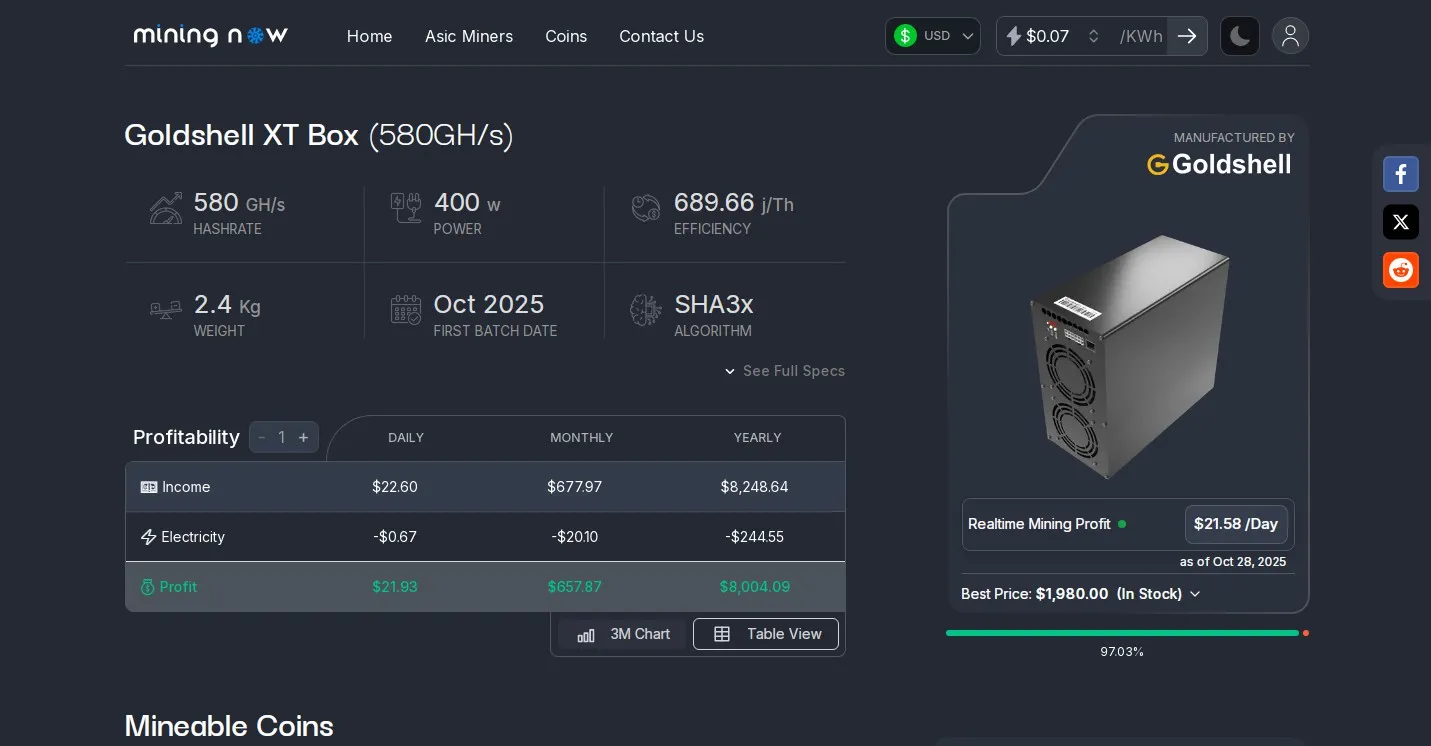
(XT Box earnings data. Source: MiningNow, October 28, 2025.)
Meanwhile, Tari mainnet SHA3X hashrate had reached 342.1 TH/s, with 15,103 active miners and an average block time of 2 minutes. The system was running stably.
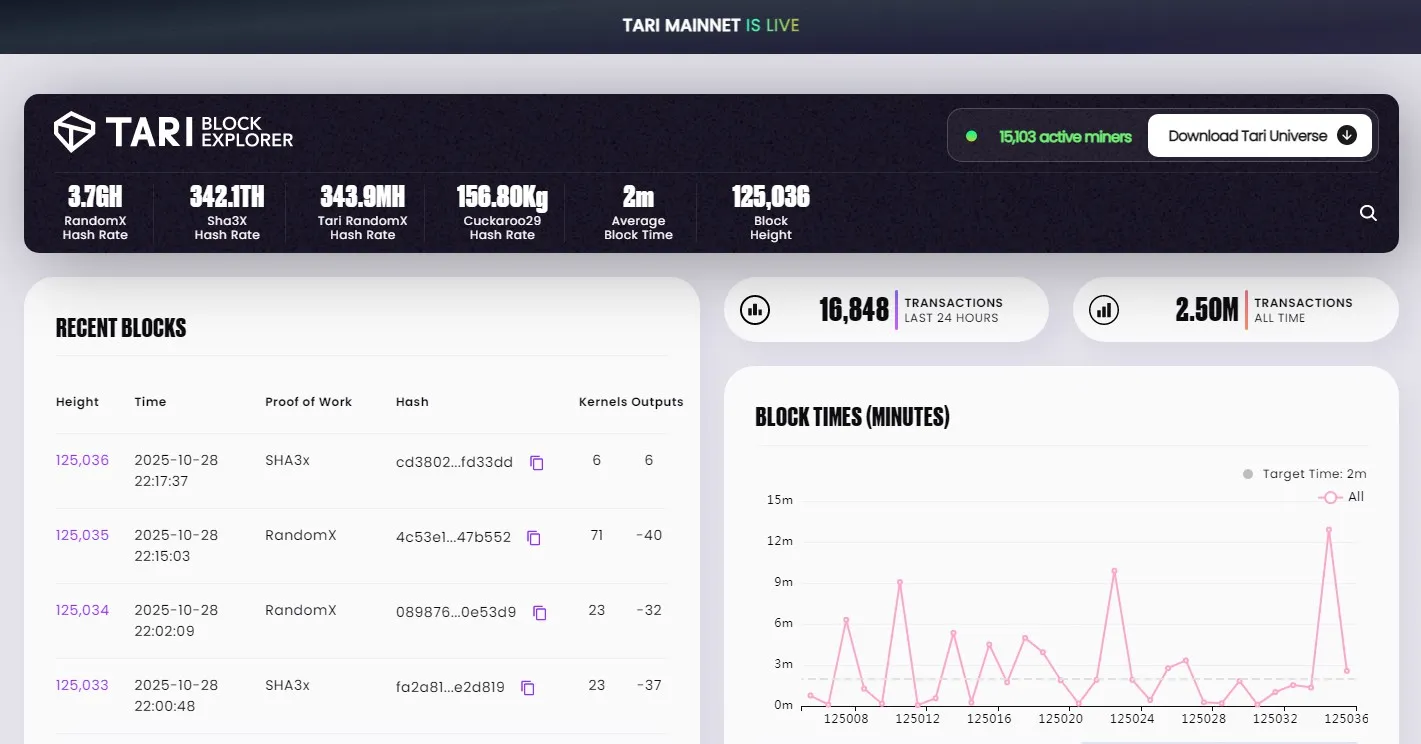
(Tari network status. Source: Tari Block Explorer, October 28, 2025.)
The latest figures partly supported Rabid Mining’s assessment.
Changes in XT Box earnings were driven mainly by the coin’s price rather than a surge in hashrate.
The network had grown while remaining stable, indicating resilience in Tari’s consensus layer.
In the broader market context, this period of volatility was not unusual.
Falling prices squeezed margins while also curbing speculative expansion to some extent.
With the XT Box in operation, Tari’s mining economics could be systematically measured, compared, and tracked. The idea of a “privacy chain” was now being tested in the market.
Rabid’s analysis was not a forecast but a judgment grounded in experience.
Through a miner’s eyes, he presented Tari as a dynamic system shaped by coin prices, hashrate, and expectations for the ecosystem.
For the community, that offered a more concrete reference point than conviction alone.
The XT Box’s significance may lie less in its earnings than in the additional possibilities it reveals for Tari.
The ideas, the network, and the market are informing one another.
That, in itself, may be another step forward for the Tari ecosystem.
Sources
This article draws on the following public sources:
- Original video (Rabid Mining):
https://www.youtube.com/watch?v=bOaclqlOqY0 - Pool data (MiningPoolStats · Tari SHA3X):
https://miningpoolstats.stream/tari-sha3x - Live earnings data (MiningNow):
https://miningnow.com/asic-miner/goldshell-xt-box-580gh-s/ - Tari mainnet block explorer (Tari Explorer):
https://explore.tari.com/ - Manufacturer’s website (Goldshell):
https://www.goldshell.com/product/goldshell-xt-box/