Table of contents
Open Table of contents
- Introduction
- 1. The Post That Rekindled Interest in Privacy
- 2. Another ZEC Rally: The Market Reprices Privacy
- 3. How the Privacy Narrative Evolved: From Money to Protocols
- 4. Tari: Privacy by Design
- 5. Monero and Tari: Two Directions for Privacy
- 6. Monero Is Untraceable. Can Tari Be Traced?
- 7. The Future of Privacy: From Defending It to Building It In
- Closing Thoughts
Introduction
One post from Naval brought privacy back into the spotlight.
ZEC soared, XMR picked up, and Tari attracted fresh attention.
This was more than a frenzy over prices. It was the return of an idea with deep roots in the history of crypto.
1. The Post That Rekindled Interest in Privacy
In early October, Silicon Valley investor Naval Ravikant posted a pointed observation on X:
“Bitcoin is insurance against fiat. Zcash is insurance against Bitcoin.”
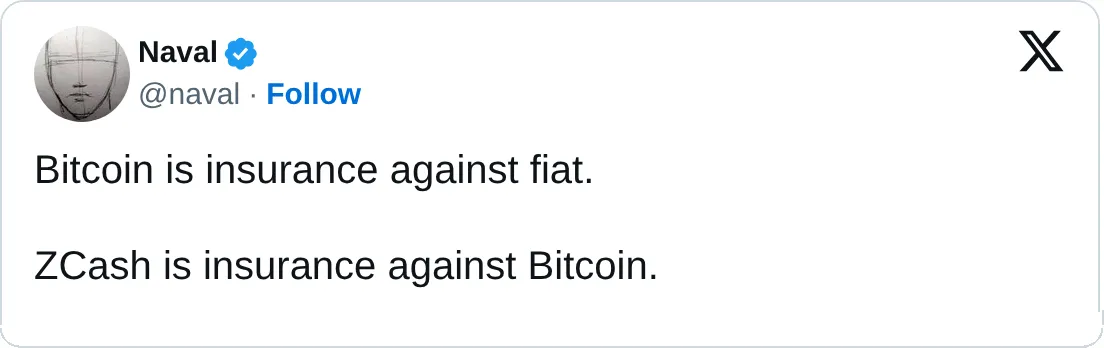
A few words brought a long-overlooked sector back into focus.
ZEC climbed from $50 to $230 in a week, gaining more than 300%.
More importantly, the rally drew attention to a question the market had neglected for years:
In a blockchain world where so much is visible, can we still preserve the privacy we need?
Naval’s remarks did not come out of nowhere. He invested in Electric Coin Company, the company behind Zcash, back in 2015.
He knows how ZEC’s technology works, but he also understands the power of the privacy narrative.
As the market becomes absorbed in the efficiency of AI and real-world assets, a commitment to privacy has become increasingly rare.
2. Another ZEC Rally: The Market Reprices Privacy
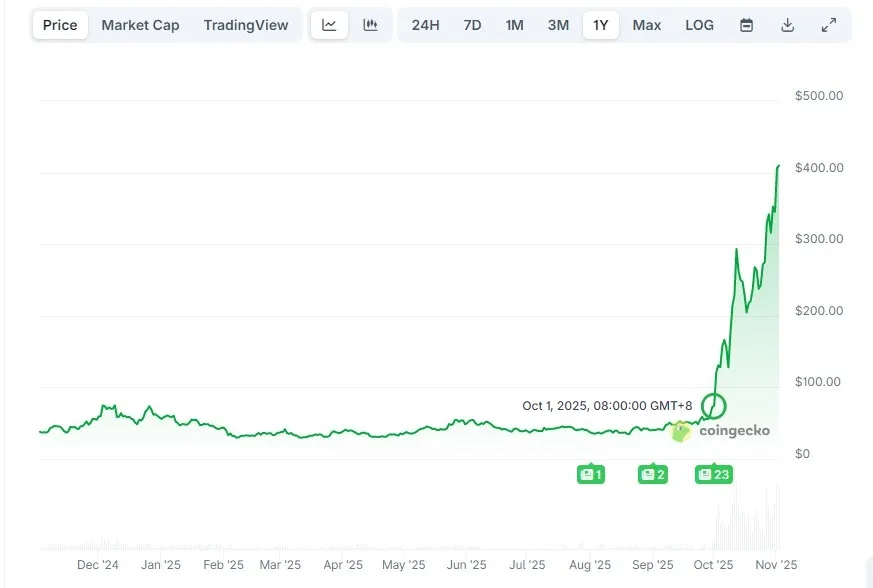
As of November 1, ZEC was trading at $420, up 17.3% in 24 hours and 52% over seven days.
It had gained 472% since Naval’s bullish post on October 1.
Prominent crypto commentators and industry figures soon joined in.
On October 30, BitMEX co-founder Arthur Hayes said:
“Nothing can stop this train. ZEC is going to $10,000.”
The next day, he posted again, expressing a bullish outlook for a break above $400.
As ZEC passed $430, crypto commentator Ansem also weighed in:
“Buying Zcash (ZEC) at $432 is like buying Bitcoin at $432.”
The broader privacy coin sector rallied too:
- Its total market capitalization reached $22.7 billion, up 7.3% in 24 hours;
- Trading volume over that period was approximately $2.4 billion;
- Dash was at $55.43, up 22.2%;
- XMR was at $331.6, up 3.6%;
- LTC was at $95.49, up 2.2%.
This was more than a sentiment-driven bounce. It signaled that privacy was moving beyond a niche investment theme and being repriced by mainstream capital.
ZEC’s surge reflected changes on three levels:
- Capital:
The market was beginning to reconsider the long-term scarcity of privacy assets. As regulation demands greater transparency and identity moves onchain, anonymity offers a new investment hedge. - Technology:
ZEC remains one of the few mature zero-knowledge privacy ledgers. Reliable zk-SNARK technology and support from multiple wallets make it usable in practice. - Narrative:
As auditing becomes pervasive and AI identification systems spread, privacy is once again seen as a last line of defense for a free world.
Behind this renewed interest, Tari’s approach to privacy built into the structure of a protocol may offer a more enduring direction as the market reconsiders the value of privacy.
3. How the Privacy Narrative Evolved: From Money to Protocols
Privacy did not emerge overnight. It has followed a clear line of development.
Each structural shift in crypto has raised the question of privacy again.
Technology changes. Systems are reorganized.
But the question of privacy never goes away.
From excessive fiat issuance to Bitcoin’s (BTC) consensus-enforced supply limit;
From hidden transactions on the darknet to scrutiny at centralized exchanges;
The flame of privacy has lived on in Monero,
And found new life in Tari.
The Historical Timeline
| Stage | Period | Event and significance |
|---|---|---|
| Bitcoin’s birth | 2009 | Decentralized money emerges, challenging sovereign credit systems. |
| Darknet adoption | 2011 (the launch of Silk Road) | BTC finds a real use as a medium of exchange on the darknet. |
| Centralized exchanges emerge | 2010–2013 | Mt.Gox, Bitstamp, and other exchanges provide fiat on-ramps for BTC. |
| The move toward KYC and verified identities | 2013–2014 | FinCEN and FATF advance regulation, and centralized exchanges begin requiring identity verification. |
| Monero launches | April 2014 | Based on CryptoNote, Monero pursues complete anonymity. |
| Darknet markets adopt privacy coins | 2016–2017 | BTC’s traceability and tighter regulation lead darknet markets to begin accepting XMR. |
| Tari begins | From 2018 | Former Monero core developer Riccardo Spagni initiates the project, using Mimblewimble to rethink how privacy is structured. |
The Logic Behind the Evolution
- BTC: An introduction to decentralization
For the first time, people could control assets without permission, while a public ledger provided verifiable transaction records. - The darknet: An early awakening to privacy
Silk Road demonstrated the social value of private money, but also exposed BTC’s traceability. - Centralized exchanges and regulation: An unintended push toward privacy
Identity requirements at exchanges made privacy a concern for ordinary users, not just those using darknet markets. - Monero: Privacy as uncompromising protection
Ring signatures, stealth addresses, and confidential transactions addressed traceability, returning money to its foundations: ownership without tracking or scrutiny. - Tari: From protection to architecture
Built on Mimblewimble, Tari starts with privacy in the protocol’s structure, preserving anonymity while retaining verifiability and scalability.
Tari is a natural continuation of this development.
It was not created to evade regulation, but to make the right to choose privacy part of the architecture.
4. Tari: Privacy by Design
In this history, Tari (XTM) represents a new exploration of privacy.
Rather than making anonymity the end goal, it takes privacy built into the protocol as its starting point.
| Dimension | Zcash / Monero | Tari |
|---|---|---|
| Form of privacy | Cryptographic shielding through zero-knowledge proofs or ring signatures | Privacy inherent in Mimblewimble’s structure |
| Ledger verification | Additional proofs required | Aggregated transactions are inherently verifiable |
| Data storage | Full history retained | Historical data can be pruned for a lightweight, scalable ledger |
| Ecosystem compatibility | Closed systems | An open layer that can connect to Layer2 and cross-chain systems |
| Role | Anonymous currencies | Private settlement layer |
Tari embeds privacy rather than placing a shield over the data.
Every XTM transaction is anonymized as it is aggregated. Applications above it, whether the Blink payment agent or other services, can inherit this privacy structure without additional mechanisms.
5. Monero and Tari: Two Directions for Privacy
When it comes to privacy, isn’t Monero already the strongest option?
The question highlights two distinct philosophies of privacy technology.
One seeks complete concealment; the other seeks to preserve privacy within an ordered system.
They are not competitors, but two directions in privacy’s development.
Monero protects individual privacy; Tari builds a world around privacy.
Monero gives freedom a refuge, allowing people to remain untracked.
Tari supplies the architecture that lets systems work with privacy.
1. Different Starting Points: Continuing and Extending the Idea
| Dimension | Monero (XMR) | Tari (XTM) |
|---|---|---|
| Design goal | Maximize transaction anonymity | Extend privacy into settlement while improving verification and scalability |
| User perspective | “No one can know whom I send money to.” | “My privacy is preserved, and the system can still verify consistency.” |
| Network philosophy | Freedom through defense | Freedom through architecture |
| Typical use | Fully anonymous payments | An ecosystem with privacy built into its architecture (Layer2) |
Tari is not Monero’s opponent.
It extends that work, taking privacy from a form of defense to a principle of system design.
2. Different Technical Paths, Shared Roots
| Technical feature | Monero | Tari |
|---|---|---|
| Privacy mechanism | Ring signatures + stealth addresses + confidential transactions | Mimblewimble (output aggregation + an addressless ledger + Pedersen commitments) |
| Transaction structure | Individually signed transactions with multiple layers of obfuscation | Transactions aggregated into a block’s net balance, with historical data safely prunable |
| Source of anonymity | Obscures links between identities | Aggregation hides transaction paths |
| Scalability | A complete but larger ledger | Less data and faster node synchronization |
| Auditability | Almost impossible to audit | Selective disclosure possible |
Monero achieves anonymity through obfuscation.
Tari builds privacy through aggregation.
Different paths, the same goal.
3. Different Philosophies: Protecting and Building
| Dimension | Monero | Tari |
|---|---|---|
| Worldview | “Privacy is a defense of freedom.” | “Privacy is a capability systems should provide.” |
| Goal | Give individuals a fully anonymous refuge | Preserve both privacy and verifiability in an open network |
| User’s role | Guardian | Architect |
Monero defends privacy.
Tari makes privacy part of the system’s language.
6. Monero Is Untraceable. Can Tari Be Traced?
By default, Tari transactions are also untraceable.
An observer cannot tell who paid whom, or how much was sent.
In theory, however, Tari offers an optional route for auditing beyond what Monero provides.
That means:
- For ordinary observers, Tari is untraceable, just like Monero.
- For users themselves, Tari allows voluntary transaction disclosure.
- At the protocol level, Tari has no transaction graph and retains no address history.
1. Anonymity in Mimblewimble’s Structure
- An addressless structure: Both parties collaborate to sign a transaction, with no public-key addresses.
- Hidden amounts: Pedersen commitments are used (C = v·G + r·H).
- Aggregation and cut-through: Blocks retain only net inputs and outputs; intermediate data is physically removed.
- A prunable ledger: Old transaction records can be safely removed, making their paths impossible to reconstruct.
Tari therefore has no traceable transaction graph in its structure.
Like Monero, it is fully anonymous to outside observers.
2. Optional Transparency: A Right to Choose
Tari differs in retaining selective transparency:
- Businesses or projects can generate a view key to disclose information to external auditors;
- Users can voluntarily prove that a transaction exists for reconciliation or compliance.
Tari is anonymous by default, but permits disclosure by choice.
Monero is anonymous by default, with almost no scope for disclosure.
7. The Future of Privacy: From Defending It to Building It In
The next phase of privacy may be about more than stronger anonymity. It may involve building privacy more deeply into the architecture of systems.
Aztec explores programmable privacy on L2, Railgun provides relay-based privacy on EVM chains, and Tari is building a public settlement layer with built-in privacy that anyone can verify and use.
Privacy would no longer be a defensive stance, but a property of the network. It would not require a separate choice; it would be there by design.
These projects pursue related ideas at different layers.
They may point to a shift from defending privacy to building systems around it.
Closing Thoughts
The return of the privacy narrative is more than a brief market rally. It reflects a long history of technological development.
As ZEC, Railgun, and Aztec reenter the conversation, Tari’s long-term value becomes clearer too.
It is not a standalone privacy coin, but a blockchain that provides the foundations for freedom, compliance, and innovation.
Monero showed us that freedom can be protected.
Tari takes that idea further: when we do not want to be monitored or tracked, a system can still respect our choice.
Privacy is moving from something we defend to something we build into our systems.
Freedom, too, is being redefined.
Related Links
- Naval Ravikant:
https://x.com/naval/status/1973254136394293708 - Arthur Hayes:
https://x.com/CryptoHayes/status/1983800865053200563 - Ansem:
https://x.com/blknoiz06/status/1984458541906739377 - BlockBeats:
https://www.theblockbeats.info/flash/318641 - CoinGecko (Zcash / ZEC):
https://www.coingecko.com/en/coins/zcash