Table of contents
Open Table of contents
- On the Eve of a Hard Fork, Building Connections to the Future
- 1. A New Phase for Mainnet: v5.0 Released
- 2. C29 Consensus Activation Height Set to
95000 - 3. XTM Arrives on Gate and MEXC, Expanding Market Access
- 4. Kraken Adds Tari to Its Listing Roadmap
- 5. Ootle and the Dual-Token System Prepare for Ecosystem Growth
- 6. Mainnet Mining Pool Block Shares: Early Signs of PoW Diversity
- 7. Development Roadmap and Outlook
- From Architecture to Applications: Putting Progress to the Test
On the Eve of a Hard Fork, Building Connections to the Future
In the previous issue, we looked back at eight years of development as Tari moved from a privacy-focused base chain toward cross-chain connectivity. This time, we stand at a new technical threshold: a hard fork has been scheduled, communication protocols are being reworked, multiple trading platforms have embraced XTM, and feedback between the ecosystem and the market is beginning to take shape.
Tari is moving from protocol optimization toward a more connected ecosystem. Its underlying architecture continues to strengthen, while the first major consensus upgrade since mainnet launch is set to take effect at block 95,000.
1. A New Phase for Mainnet: v5.0 Released
On September 1, 2025, Tari released mainnet v5.0.0. This system-wide upgrade covers wallet communication, network discovery, consensus rules, chain cleanup, registration logic, and other modules, making it the largest technical evolution since mainnet launch.
The subsequent v5.0.1 release quickly addressed critical issues such as connection failures at startup, demonstrating the development team’s responsiveness.
Key improvements include:
- Reworked wallet communication architecture: The previous
commsmodule has been removed in favor of HTTP-based communication with remote nodes. Users no longer need to configure the target node’s public key, substantially simplifying remote connections. Although the Tari wallet has effectively supported a lightweight mode from the outset through remote-node synchronization, a shortage of fully configured remote nodes limited its practical usefulness. This update lays the groundwork for wider deployment of lightweight and web wallets. - Network connection improvements: Invalid seed nodes are excluded, improving wallet startup and synchronization success rates.
- Expanded gRPC interfaces: More granular remote calls and status monitoring are supported.
- Greater chain-data robustness: Bad blocks are automatically removed, and accumulated difficulty checks have been added.
- VN registration fixes: The minimum participation requirement of 1000 uT has been clarified to reduce registration failures.
2. C29 Consensus Activation Height Set to 95000
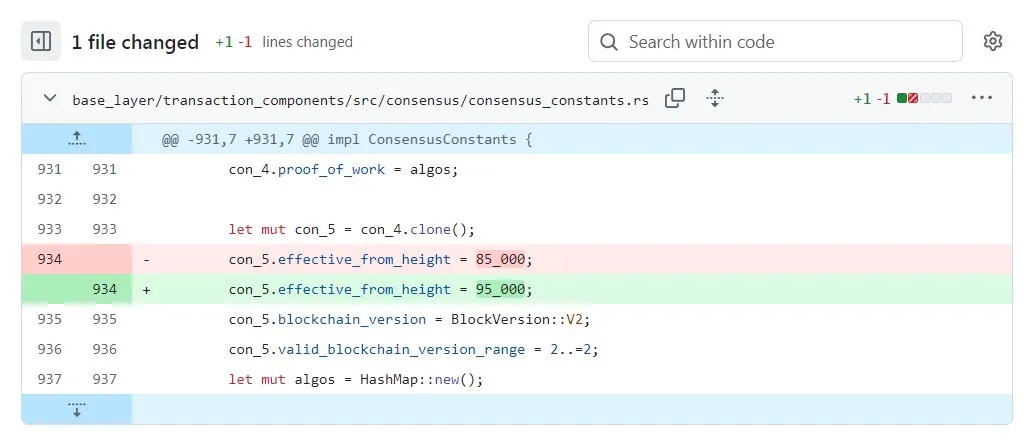
Following discussion and practical calculations, the activation height for the Cuckaroo29 (C29) algorithm has been set at block 95,000, with activation expected at:
September 16, 2025, at 18:00 (Beijing time, UTC+08:00)
This upgrade will move Tari’s consensus structure from three lanes to four:
| Stage | Algorithms | CPU/GPU Share |
|---|---|---|
| Three lanes (current) | RandomX merged mining + RandomX standalone mining + SHA3 | CPU 66% / GPU 33% |
| Four lanes (after upgrade) | + Cuckaroo29 (GPU-friendly) | CPU 50% / FPGA/ASIC 25% / GPU 25% |
C29 is a lightweight, ASIC-resistant algorithm that opens a new entry point for GPU miners. It is intended to enhance network diversity and security while laying the technical groundwork for broader community participation.
It is worth noting that SHA3X is not particularly GPU-oriented. The Tari team has repeatedly emphasized a target allocation of 50% CPU, 25% GPU, and 25% ASIC/FPGA, intended to encourage diverse sources of hash power and avoid concentration. The new C29 algorithm primarily targets GPUs, broadening participation and delaying the point at which specialized mining hardware dominates, giving the community a wider opportunity to take part.
“ASIC resistance” is more about delay than permanent protection. Historically, specialized mining hardware has appeared after algorithms such as Grin and Aeternity’s C29/C31, and even Monero’s RandomX, had been running for some time. The reason is straightforward: if an algorithm is stable enough and the coin price attractive enough, ASIC manufacturers have an incentive to invest in development. Tari’s choice of C29 is therefore not about eliminating ASICs altogether, but about giving GPU miners a longer window of participation, delaying premature concentration of hash power, and supporting a more diverse network in its early stages.
3. XTM Arrives on Gate and MEXC, Expanding Market Access
July 30, 2025, marked an important moment for Tari: its native token XTM was listed on two major exchanges, MEXC and Gate.io, opening access to spot trading for more than 70 million users worldwide.
Gate.io first announced the listing of Tari’s cross-chain asset wXTM, opening the wXTM/USDT trading pair that day. This marked the bridged asset’s first entry into a mainstream regulated exchange. MEXC then announced XTM/USDT, alongside an airdrop incentive campaign offering 10 million XTM and 15,000 USDT, attracting considerable community attention.
The two platforms’ simultaneous listings marked Tari’s move beyond its early informal markets into a phase supported by centralized exchanges, laying the groundwork for deeper liquidity and easier ecosystem access.
| Exchange | Listing Date | Asset | Trading Pair | Status |
|---|---|---|---|---|
| MEXC | 2025.07.30 | XTM | XTM/USDT | Listed in the Innovation Zone; trading available |
| Gate.io | 2025.07.30 | wXTM | wXTM/USDT | Featured in the Launch project section; trading available |
Community feedback showed that many users were asking whether an airdrop checker was available, alongside strong interest in Tari’s community incentives and plans for further CEX expansion. What had previously been limited to OTC and DEX activity had entered a phase of broader exchange-based trading.
4. Kraken Adds Tari to Its Listing Roadmap
On July 5, 2025, Kraken added Tari’s cross-chain asset wXTM to its Listings Roadmap, marking it as “Under Consideration.” This was Tari’s first appearance among potential listings on a mainstream U.S. regulated exchange, with several implications:
- Progress toward regulatory acceptance: Kraken is among the CEXs most focused on regulatory compliance. Its consideration of wXTM points to a potential path toward acceptance of Tari’s cross-chain asset within that framework.
- A showcase for bridging standards: wXTM uses LayerZero’s OFT standard to bridge to Ethereum. Its transparent, secure, cross-chain design aligns with Kraken’s requirements for standardized assets.
- A signal for North American market access: If approved for listing, Tari would gain trading channels into the U.S. and European markets, becoming one of the relatively few base-layer protocols combining privacy features with regulated exchange access.
Although no listing date had been announced, inclusion on the roadmap was itself a milestone, laying an ecosystem foundation for Tari’s future expansion into DeFi, stablecoins, asset mapping, and multichain applications.
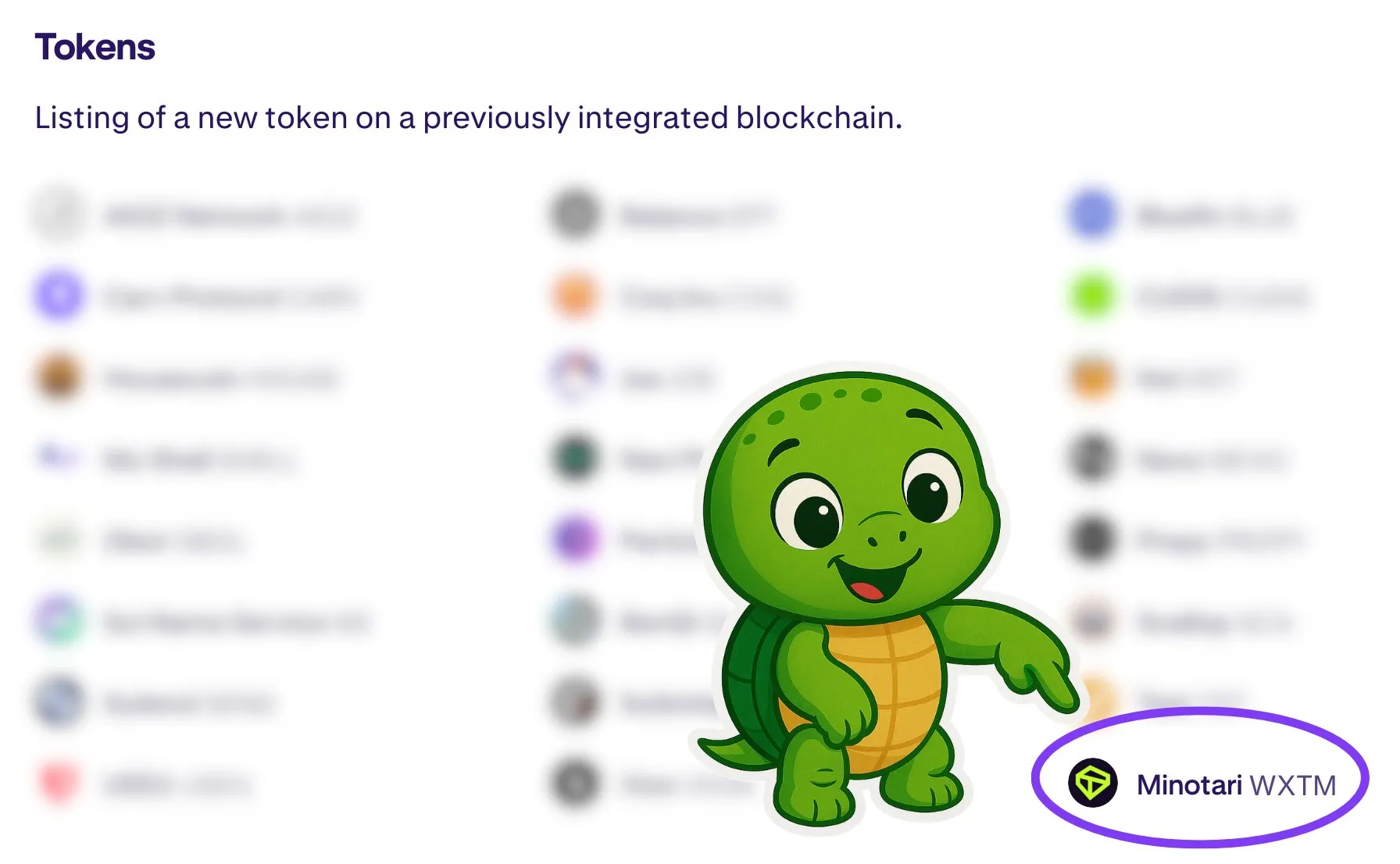
https://www.kraken.com/listings
5. Ootle and the Dual-Token System Prepare for Ecosystem Growth
Tari’s dual-token architecture continues the core approach discussed in the first issue:
| Token | Role | How It Is Obtained | How It Is Used |
|---|---|---|---|
| XTM | Mainnet value anchor | PoW mining | Creating XTR and paying transaction fees |
| XTR | Layer2 execution fuel | Burning XTM in exchange | Burned during contract calls and application execution |
Once mainnet is stable, the Ootle Layer2 network is intended to support a programmable ecosystem of smart contracts, asset issuance, and DeFi applications, gradually expanding the uses of XTR.
This forms Tari’s three-layer value cycle: XTM as the anchor → XTR as fuel → Ootle usage → further consumption.
6. Mainnet Mining Pool Block Shares: Early Signs of PoW Diversity
At block height #89440, the sample covered 1001 Tari mainnet blocks. We classified their mining pool and proxy identifiers to produce the following block-share pie chart:
Sample range: block heights 88440 through 89440
Method: classification by the Miner Extra Data field in block headers, with WUFJagtech entries grouped together
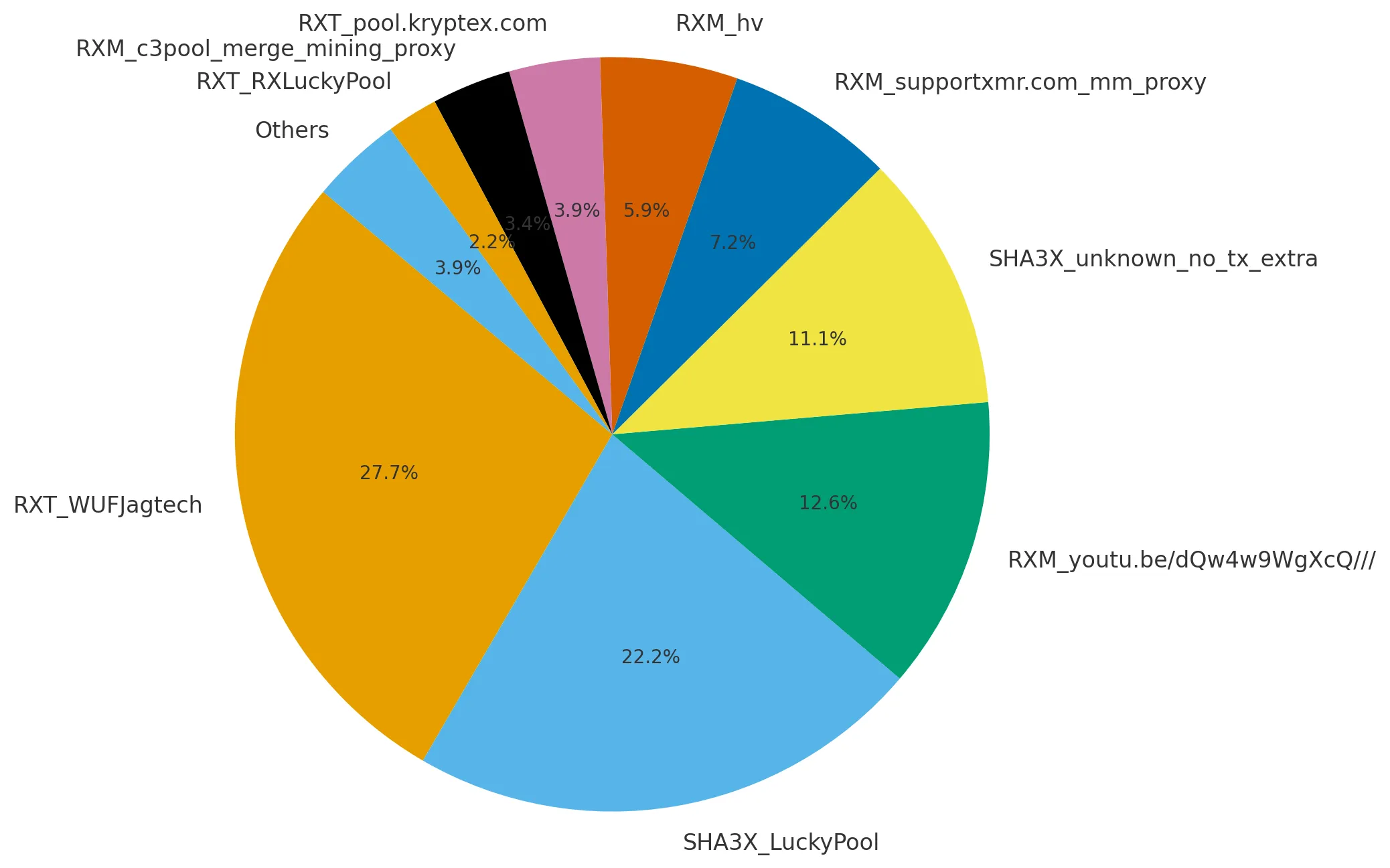
The RXT_WUFJagtech group led with approximately 27.74% of blocks. It comprises multiple sub-proxies, including S1~S3, E0~E2, and U0~U2, reflecting a combination of distributed deployment and centralized coordination.
SHA3X_LuckyPool followed with 22.16%, continuing its consistent block production on Tari mainnet. The distinctive proxy identifier youtu.be/dQw4w9WgXcQ/// accounted for 12.57% of the sample.
Several RXM proxies also maintained consistent block production. supportxmr.com_mm_proxy accounted for 7.19%, while hv, c3pool_merge_mining_proxy, and related entries together contributed around 9%. Meanwhile, SHA3X_unknown_no_tx_extra accounted for 11.08%; its identity remained unclear and warranted further tracking.
The main sources of blocks were:
| Mining Pool / Proxy | Share |
|---|---|
| RXT_WUFJagtech | 27.74% |
| SHA3X_LuckyPool | 22.16% |
| RXM_youtu.be/dQw4w9WgXcQ/// | 12.57% |
| SHA3X_unknown_no_tx_extra | 11.08% |
| RXM_supportxmr.com_mm_proxy | 7.19% |
| RXM_hv | 5.89% |
| RXT_pool.kryptex.com | 3.89% |
| RXM_c3pool_merge_mining_proxy | 3.39% |
| RXM_tari_merge_mining_proxy | 1.50% |
| Others (remaining smaller proxies) | 3.49% |
The block data was exported using the community tool github.com/Snipa22/go-tari-tools, then manually classified, with WUFJagtech entries consolidated.
View the block records: https://core.tari.jagtech.io/winners_1000.txt
The chart shows the current distribution of Tari PoW block production across proxies. It also suggests that the activation of GPU-friendly C29 will change the composition of network participation again. We will continue tracking consensus developments and changes in block production in the next issue.
Special thanks to community member Alexander Blair for his help with data verification and technical explanations. He identified the WUFJagtech (US1) sub-node omitted from the statistics and clarified the design target for SHA3X consensus: an expected mainnet hash-power allocation of 50% CPU, 25% FPGA/ASIC, and 25% GPU, with SHA3X not specifically optimized for GPUs. He also shared the open-source go-tari-tools tool used to generate block data, providing a solid basis for this issue’s analysis.
7. Development Roadmap and Outlook
Completed:
- Mainnet upgrades to v5.0.0 / v5.0.1
- C29 activation height set
- wXTM cross-chain launch (one-way to Ethereum)
- XTM listings on multiple platforms
In progress:
- Bridging wXTM back
- Full replacement of the wallet’s comms module with gRPC
- Deployment interfaces for contracts that consume XTR
Target areas:
- Lightweight wallets and web prototypes: Explore PWAs or browser extensions to lower barriers to Tari Layer1 and Layer2, improve accessibility, and enhance the mobile experience.
- Bidirectional asset mapping: Standardize ERC20 ↔ Layer2 contract-asset mapping, creating an asset bridge between Tari and Ethereum as a foundation for multichain applications.
- Cross-chain liquidity expansion: Establish stable liquidity pools on Uniswap while opening wXTM channels through regulated platforms such as Kraken, creating complementary DeFi and CEX trading routes.
- Layer2 contract templates: Provide open-source, reusable Tari Layer2 contract templates for NFTs, peer-to-peer payments, social accounts, and other use cases to lower the barrier for developers and encourage applications that consume XTR.
From Architecture to Applications: Putting Progress to the Test
From hard forks to exchange listings, and from Layer1’s PoW security to Layer2’s asset system, Tari is gradually strengthening its underlying network and expanding its connections to other ecosystems. These developments are worth documenting, but they do not mean the project has reached maturity.
In this issue, our focus is less on whether Tari has already “taken off” and more on the foundations it is building. Whether consensus upgrades roll out smoothly, wallets become more reliable and easier to use, and Ootle can support applications that people actually use are all questions worth following.
Real value lies not only in architecture and roadmaps, but also in whether those commitments become usable products and genuine usage, step by step.