Table of contents
Open Table of contents
- Tari: A Web3 Protocol Forged Through Eight Years of Development
- 1. Mainnet Status (as of June 16, 2025)
- 2. Exchanges Listing XTM (as of June 2025)
- 3. Consensus Evolution: From Two Mining Lanes to Four
- 4. The wXTM Bridge Goes Live: Connecting to Ethereum
- 5. Tari Universe App Updates
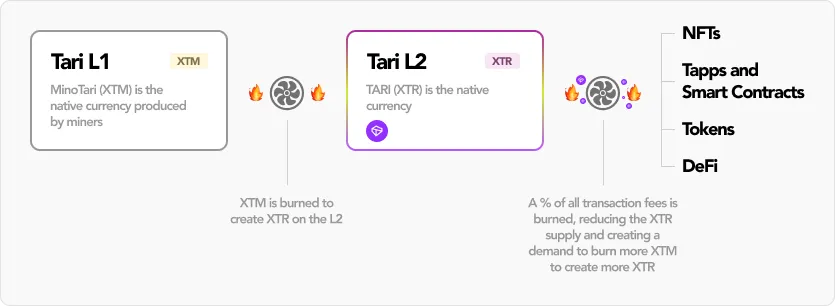
- 6. The Dual-Token Model and Layer 2 Architecture: XTM and XTR Power Ootle
- 7. Looking Ahead: A Stablecoin Combining Privacy and Compliance
Tari: A Web3 Protocol Forged Through Eight Years of Development
In crypto, many projects attract attention overnight, only to fade away a few months later. Tari is one of the few taking a steadier path, moving forward through sustained development and deliberate system design.
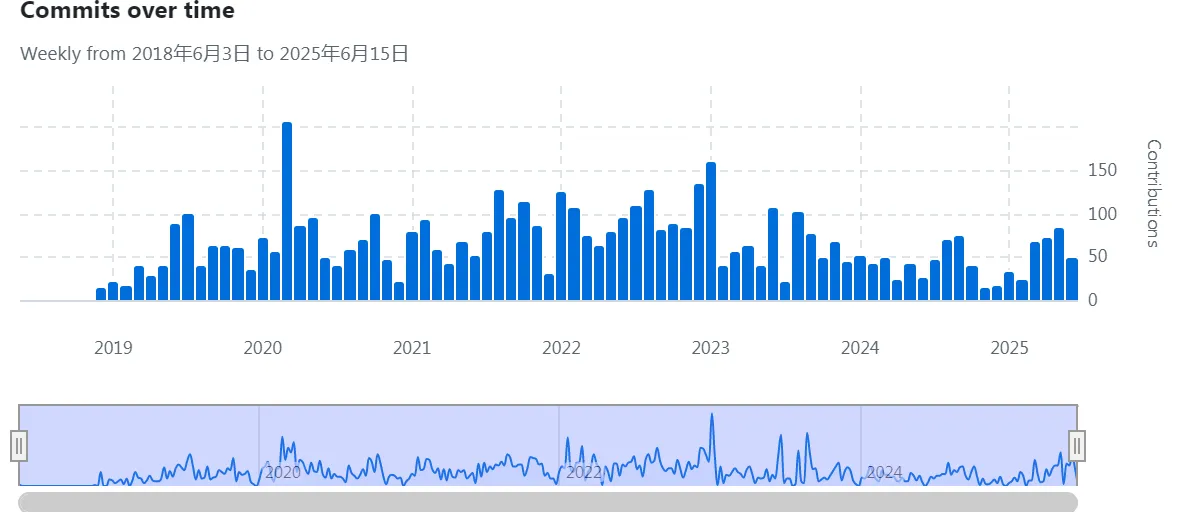
Since 2018, more than 50 developers have contributed to Tari’s mainnet codebase. Over eight years, they have made thousands of commits, with more than 4,477,434 lines of code added or removed. That work reflects not just new features, but continued refinement of the architecture and a commitment to the ideas behind it.
Several trends stand out:
- Since 2023, development activity has risen substantially, with more frequent updates.
- Core developers including sdbondi, SWvheerden, and stringhandler have contributed consistently, advancing Layer 2, wallets, security protocols, and other key components.
- From its beginnings as a privacy-focused Layer 1, the project has expanded to include NFT support, asset mapping, on-chain governance, and merge mining, forming a clearly structured, modular protocol designed to keep evolving.
Tari takes a whole-system approach: Mimblewimble provides the privacy foundation, while a layered architecture and flexible services aim to make Web3 both private and open, robust and usable.
In an industry too often caught in a cycle of pumps, retail losses, and collapse, Tari is taking another route: earning trust over time and building value through code.
1. Mainnet Status (as of June 16, 2025)
- Active miners: 14,900
- Tari RandomX hash rate: 1.4 GH/s
- RandomX merge-mining hash rate: 3.8 GH/s
- Sha3X hash rate: 107.7 TH/s
- Average block time: 2 minutes
- Current block height: 29,306
2. Exchanges Listing XTM (as of June 2025)
| Exchange | Trading pair |
|---|---|
| SafeTrade | XTM/USDT |
| TradeOgre | XTM/USDT |
| XT.COM | XTM/USDT |
| CoinEx | XTM/USDT |
| Nonkyc.io | XTM/USDT |
| Biconomy | XTM/USDT |
3. Consensus Evolution: From Two Mining Lanes to Four
Tari’s merge-mining model continues to evolve, with a balance between CPU and GPU mining at its core, alongside stronger network security and decentralization. The stages below outline how its consensus structure is changing.
To improve fairness and broaden miner participation, the core development team is preparing a major hard fork. The team says it will build on lessons from the previous fork, with smoother coordination and node upgrades. Tari Universe will also continue to focus on stability and connectivity, improving synchronization and the setup experience.
Two Lanes (Previous Stage)
- 50% RandomX merge mining with Monero
- 50% SHA3
CPU share: 50% | GPU share: 50%
Three Lanes (Current Structure)
- 33% RandomX merge mining
- 33% standalone RandomX mining
- 33% SHA3
CPU share: 66% | GPU share: 33%
Four Lanes (Upcoming Fork)
- 25% RandomX merge mining
- 25% standalone RandomX mining
- 25% SHA3
- 25% Cuckaroo29, a lightweight, GPU-friendly, ASIC-resistant graph algorithm
CPU share: 50% | GPU share: 50%
This change is intended to broaden hardware diversity, strengthen resistance to centralization, and make mining more accessible and equitable worldwide.
The three-way structure will become a four-way split, with each proof-of-work algorithm assigned 25%. The new Cuckaroo29 algorithm performs well on GPUs and opens the door to a large community of GPU miners, including many who previously could not participate in Tari mining.
The change is expected to raise the network’s overall hash rate while increasing competition among miners, leading to higher overall mining difficulty.
4. The wXTM Bridge Goes Live: Connecting to Ethereum
Tari Universe v1.2.0, codenamed “The Flourishing,” has launched, bringing Tari’s cross-chain functionality online:
- Users can bridge XTM to Ethereum mainnet with one click and receive wXTM in MetaMask.
- wXTM is available on Uniswap, with swaps involving ETH and ERC-20 tokens planned for the Tari client.
- wXTM uses LayerZero’s OFT standard, providing a foundation for expansion to additional chains.
The bridge is currently an MVP and supports only the XTM → wXTM direction. The reverse route, wXTM → XTM, is expected to open in July 2025.
This marks Tari’s first connection with the Ethereum ecosystem, laying the groundwork for asset interoperability, cross-chain governance, and DeFi use.

5. Tari Universe App Updates
Android v1.1.4
- APK installation packages can now be downloaded from GitHub.
- Exchange deposit addresses can now be saved to contacts.
iOS v1.1.0
- Added the ability to save exchange deposit addresses.
- Reworked contact management to improve performance and usability.
Known Issues
- The current iOS version remains in dark mode and cannot switch to light mode.
- Some interface inconsistencies remain; the team is working on fixes.
Desktop v1.2.9 (Codename: Colonies of Light)
- Lists all centralized exchanges that support XTM, with one-click links to their trading pages.
- Reworks the transaction history interface and adds bridge records for a clearer, more readable layout.
- Adds Tor module support on Linux to simplify installation and improve compatibility.
- Improves node downloads and configuration, substantially reducing common problems such as node setup failures.
- Improves stability and responsiveness, including the experience on lower-spec devices.
- Fixes cases where the mining button in the Airdrop Game was slow or unresponsive.
6. The Dual-Token Model and Layer 2 Architecture: XTM and XTR Power Ootle
Tari’s economic system uses two tokens, serving the mainnet and Layer 2 respectively. The design aims to combine steady issuance with deflationary incentives across the ecosystem.
XTM: The Foundation of Value
- The native Layer 1 token, issued through mainnet block production as mining rewards and burned to create XTR.
- Earned through multi-algorithm proof-of-work mining, including RandomX and SHA3.
- A base supply of 21 billion, with issuance declining linearly over the first 12 years, followed by a fixed annual inflation rate of 1%.
XTR: The Token for Layer 2 Applications
- Burning 1 XTM creates 1 XTR.
- Used to execute smart contracts, run applications, and issue assets on Tari’s Layer 2, Ootle.
- Each operation burns some XTR.
- When their XTR runs out, users need to burn more XTM to obtain it.
The model links scarcity across the two tokens: XTM is consumed to create fuel, while XTR is consumed through ecosystem use. Together, they underpin Tari’s long-term value proposition.
Ootle: A Programmable Asset Network for a Wide Range of Uses
Ootle is Tari’s Layer 2 network, built on top of the mainnet. It provides scalability and programmability for applications spanning NFTs, DeFi, social platforms, GameFi, and other Web3 use cases.
- Uses BFT consensus and sharding to support concurrent transaction processing.
- Integrates the XTR model, linking ecosystem consumption to deflation and value flowing back into the system.
- Enables users and developers to contribute value through ongoing interaction, creating a reinforcing incentive loop.
This gives Tari’s economic system three connected roles: a foundation of value, fuel for activity, and consumption through use.
XTM provides the foundation of value, XTR fuels ecosystem activity, and Ootle supports real-world use cases.
The token model and application network work together to form a verifiable, sustainable loop for long-term value.

7. Looking Ahead: A Stablecoin Combining Privacy and Compliance
In its May 2025 investment thesis, venture capital firm Hack VC disclosed plans for a stablecoin project in the Tari ecosystem combining privacy by default with compliant issuance. The project is expected to build on Ootle and remains in research and development.
According to Hack VC, the project seeks to combine Mimblewimble privacy with a high-performance Layer 2 architecture, aiming to offer both privacy protection and payment efficiency. One goal is to address the risk of on-chain payments exposing sensitive information such as a user’s income.
Source: https://blog.hack.vc/tari-investment-thesis
Note: The project remains in research and development, with no specific launch date announced.
For Tari, privacy is not a gimmick and decentralization is not a slogan. They are choices made tangible through code and architecture, one step at a time. We believe technology should serve human freedom, and protocols should address real needs rather than cater to short-lived speculative narratives.
TariTalk will continue to document Tari’s development and the changes worth paying attention to.